As transformer demand grows and lead times tighten in 2026, manufacturers are under pressure to increase output without sacrificing coil consistency. Upgrading transformer winding capacity is often the fastest lever — especially when multi-spindle platforms and automation reduce manual handling, stabilize tension, and shorten changeovers. This guide explains how multi-spindle and automatic solutions improve throughput, and what to evaluate when selecting a transformer core winding machine for your production line.
1. Transformer Core Winding Machine Bottlenecks: Where Throughput Is Lost
The Typical Manual and Semi-Auto Constraint Picture
Most manufacturers know roughly how many coils they wind per shift. Fewer have mapped where time is actually lost. The gaps are usually larger than expected.
| Throughput Loss Category | Typical Cause | Magnitude |
|---|
| Winding speed variation | Operator-dependent speed; fatigue effects across a shift | 15–30% speed variation between early and late shift |
| Tension inconsistency | Manual tension control; bobbin weight changes as wire depletes | Coil dimension variation; rework or reject |
| Bobbin and material loading | Operator stops winding to load new wire or forms | 5–15% of shift time depending on coil size |
| Tap and lead preparation | Manual marking, forming, and securing of tap leads | 3–8 minutes per coil for wound coils with multiple taps |
| Inspection and rework | Turns count error, loose turns, dimension non-conformance | Proportional to operator variability |
| Setup and changeover | Adjusting mandrel, re-threading, updating parameters for a new SKU | 20–60 minutes for complex changeovers without tooling support |
The Business Impact
A production line losing 25% of available time to these factors is not running at rated capacity — it is running at 75%. The first step in a throughput improvement project is measuring where time goes on the current line before specifying new equipment.
2. Transformer Winding Multi-Spindle Advantage: Parallel Output and Better Labor Utilization
How Multi-Spindle Systems Multiply Output
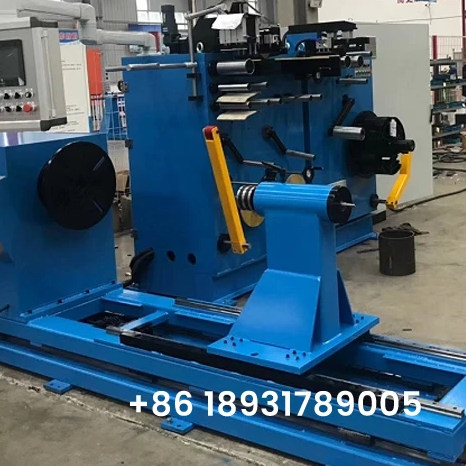
A single-spindle machine winds one coil per cycle. A multi-spindle transformer core winding machine winds two, four, or more coils simultaneously using synchronized tension and traverse control across all spindles.
| Configuration | Coils Per Cycle | Operator-to-Coil Ratio | Best Application |
|---|
| Single spindle | 1 | 1:1 | Prototypes, low volume, large complex coils |
| 2-spindle | 2 | 1:2 | Medium volume; two identical SKUs per cycle |
| 4-spindle | 4 | 1:4 | High volume; consistent small-to-medium coils |
| 6–8-spindle | 6–8 | 1:6 to 1:8 | Very high volume; standardized production |
The labor efficiency improvement is immediate — the same operator produces 4x the coils per hour on a 4-spindle machine as on a single-spindle machine for the same SKU.
Where Multi-Spindle Helps Most
High-volume repeat orders where the same coil runs for long periods between changeovers
Products with consistent wire gauge and coil geometry across the product family
Lines where labor cost is a significant component of unit manufacturing cost
Planning Considerations
SKU grouping: multi-spindle systems work best when products are grouped by wire gauge and coil dimension — mixing incompatible products on the same spindle set wastes the efficiency advantage
Material feed management: multiple spindles consume wire faster — ensure wire spool stands, creel systems, and material replenishment workflows match the increased consumption rate
Quality monitoring: confirm that the control system monitors and can alarm independently on each spindle — a defect on spindle 3 should not contaminate the other spindles' output
3. Transformer Core Winding Machine Automation: Tension, Accuracy, and Repeatability
The Quality at Speed Problem
Increasing winding speed without automation typically increases defect rate. The goal of automation is to maintain or improve quality while running faster.
| Automation Function | What It Controls | Quality Benefit |
|---|
| Closed-loop tension control | Wire tension as a function of winding speed and bobbin diameter change | Consistent layer density; no loose turns; predictable coil dimensions |
| Programmable turns counting | Electronic counting with alarm on deviation | Zero turns count errors without manual verification |
| Layer traverse accuracy | CNC-controlled traverse unit controls wire lay per layer | Consistent layer build; correct coil height and width |
| Automatic wire breakage detection | Tension sensor detects sudden loss of tension | Stops the spindle immediately; prevents scrapped coils |
| Recipe management | Stored programs for each SKU | Operator loads the program; machine sets all parameters |
| Insulation layering control | Automatic interleaving tape or paper dispenser integration | Consistent insulation between layers without manual positioning |
The Rework Reduction Effect
In a manual winding operation, a turns count error, a loose layer, or an out-of-dimension coil typically requires unwinding and rewinding — wasting the wire and the time. In an automated system:
Turns count errors are caught in real time and the spindle stops before the coil is completed
Tension deviations trigger alarms before they become dimensional problems
Recipe parameters are locked — an operator cannot accidentally run the wrong tension or traverse pitch
The practical result is higher first-pass yield and lower rework rate, which further multiplies the effective throughput improvement beyond the speed increase alone.
Traceability for Quality Management
Modern transformer core winding machines with data logging record the actual winding parameters for every coil — tension profile, turns completed, traverse data, and any alarm events. This creates a per-coil quality record that supports:
Traceability for warranty claims (was this coil wound to spec?)
Statistical process control (SPC) to detect trends before they cause defects
Customer documentation requirements for transformer quality certification
4. Transformer Winding Changeover Efficiency: Fixtures, Setup, and Workflow Integration
Why Changeover Can Erase Speed Gains
A 4-spindle machine running at twice the speed of a single-spindle machine provides the full throughput benefit only if changeover time is managed proportionally. If changeover takes 45 minutes on the 4-spindle versus 20 minutes on the single-spindle, and if the production runs are short, the speed advantage shrinks rapidly.
| SKU Run Length | Changeover Impact on Effective Output |
|---|
| Long runs (100+ coils per SKU) | Changeover is a small fraction of total run time — speed benefit dominant |
| Medium runs (20–50 coils per SKU) | Changeover begins to materially affect effective output |
| Short runs (5–10 coils per SKU) | Changeover time may approach or exceed the run time — net output benefit is small |
Features That Reduce Changeover Time
| Feature | Time Saving | Implementation |
|---|
| Quick-change mandrels and fixtures | Reduces mechanical setup from 20–40 minutes to 5–10 minutes | Standardized fixture interface; no loose fasteners |
| Stored recipe programs | Eliminates parameter re-entry for repeat SKUs | One button to load the program for a known coil type |
| Guided setup prompts | HMI walks the operator through setup steps | Reduces error; enables less-experienced operators to set up correctly |
| Pre-set tension check | Machine confirms tension is correct before winding starts | Prevents first-coil defects during a changeover |
Line Integration Considerations
Transformer winding is one step in a process that includes insulation preparation, coil binding, lead forming, and impregnation. Improving winding throughput only creates value if the downstream processes can absorb the increased output. Review the entire line before specifying new winding equipment:
Is the insulation wrapping or taping station the next bottleneck?
Can the lead forming and binding operation keep pace?
Is the VPI or dip impregnation capacity sufficient for the increased coil volume?
5. Transformer Core Winding Machine Buying Checklist
Quote-Ready Technical Requirements
| Parameter | What to Specify | Notes |
|---|
| Wire type | Round copper, flat copper, aluminum — all types used | Different wire types may require different tension systems |
| Wire gauge range | AWG or mm² minimum and maximum | Defines the tension control range and traverse pitch |
| Coil dimensions | ID, OD, height range | Determines mandrel range and traverse stroke |
| Turns range | Minimum and maximum turns per coil | Defines control system resolution requirement |
| Number of spindles | 2, 4, 6 — based on volume and SKU mix | Balance throughput vs. changeover frequency |
| Target takt time | Coils per hour at the representative SKU | Confirms whether the machine speed meets production requirements |
Acceptance Testing Plan
| Test | Method | Pass Criteria |
|---|
| Sample winding run | Wind 20 coils of the primary SKU on the production program | All coils within dimensional tolerance; no rework |
| Turns count accuracy | Compare machine count to manual verification on 10 coils | Zero deviation |
| Tension repeatability | Measure wire tension at multiple points in the cycle on 5 coils | Within ±5% of setpoint throughout the cycle |
| Changeover time | Time a complete changeover from SKU A to SKU B with a trained operator | Within the agreed target time |
| Uptime test | Run for 4 hours at production rate | No unplanned stops; alarm log reviewed |
Conclusion
Higher output does not have to mean higher defect risk. Multi-spindle automation can scale transformer winding throughput by reducing manual variability, stabilizing wire tension, and cutting non-productive changeover and loading time. The right transformer core winding machine choice depends on your coil types, SKU mix and run lengths, changeover frequency, and downstream line capacity. Measure your current line constraints first — then specify equipment that addresses the real bottleneck.
FAQ
Q1: What is the main throughput advantage of multi-spindle transformer winding?
A multi-spindle transformer core winding machine winds two, four, or more coils simultaneously with synchronized control across all spindles. One operator produces the output that previously required multiple machines or multiple operators. For high-volume repeat SKUs, this is the fastest way to increase coil production without proportionally increasing floor space or headcount.
Q2: How does automation improve coil quality on an automatic transformer core winding machine?
Automation removes the operator variability that causes most quality defects in manual winding. Closed-loop tension control maintains consistent wire tension as bobbin weight decreases. Electronic turns counting eliminates turns count errors. CNC traverse control maintains consistent layer build and coil dimensions. Recipe management ensures every operator runs the correct parameters for every SKU.
Q3: Does automation still help when I have many different coil designs?
Yes, but changeover speed becomes the critical factor. With stored recipe programs, quick-change mandrel fixtures, and guided setup prompts, an operator can change over to a new SKU in 5–10 minutes rather than 30–45 minutes. The net throughput benefit of the machine depends on the ratio of productive winding time to changeover time across the shift.
Q4: What winding parameters are most important to control for consistent coil quality?
Wire tension throughout the winding cycle, turns count accuracy, traverse pitch per layer, coil build height and diameter as a function of turns completed, and layer-to-layer insulation placement for designs with interleaved insulation. All of these should be controllable, settable by recipe, and monitorable with alarms on the machine control system.
Q5: What information is needed to get an accurate transformer core winding machine quotation?
Wire type (round copper, flat copper, aluminum) and gauge range, coil inner diameter, outer diameter, and height range, turns count range per coil, target production volume in coils per shift, preferred number of spindles, any integration requirements with upstream or downstream processes (insulation wrapping, lead forming, binding), and the SKU mix with approximate run length per SKU.
Daniel Richardson
Senior Power Systems Engineer (PE)
With 18 years dedicated to electrical infrastructure design, I specialize in advanced industrial power quality solutions. As a certified Professional Engineer, I have successfully led high-stakes substation projects, serving major Fortune 500 clients across Asia-Pacific.
 English